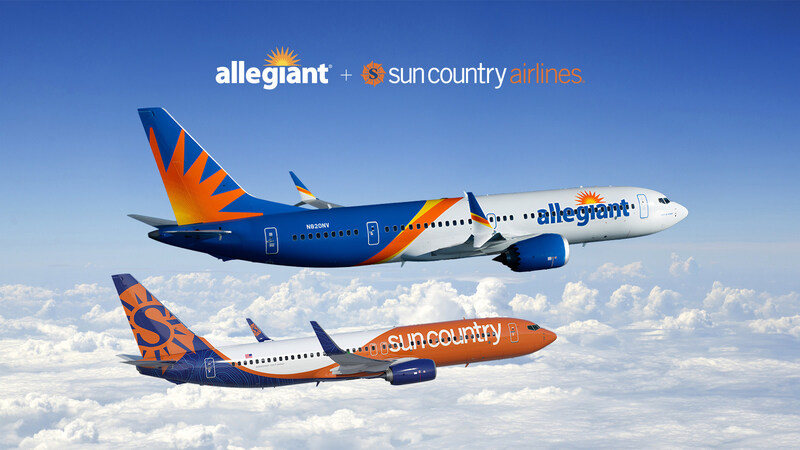
Allegiant Air and Sun Country Airlines announced that they have entered into a definitive merger agreement that would combine the two carriers into a larger leisure-focused airline in the United States. Under the terms of the deal, Allegiant will acquire Sun Country in a cash and stock transaction that values Sun Country at approximately $1.5 billion, including net debt.
Feature Image Credit: Allegiant Travel Company
The combined airline would serve an estimated 22 million passengers annually, operate nearly 650 routes, and serve close to 175 cities with a fleet of approximately 195 aircraft. Allegiant would remain the publicly traded parent company, and the combined airline would continue operating under the Allegiant name once regulatory approvals and operational integration are complete.
Network and Operational Impact
Both carriers focus primarily on leisure travel and operate flexible capacity models designed to adjust to seasonal demand. Allegiant has historically concentrated on nonstop service from small and mid-sized cities to vacation destinations, while Sun Country has a stronger presence in larger metropolitan markets and international leisure routes.
The merger would connect Sun Country’s Minneapolis-St. Paul (MSP) hub with Allegiant’s broader network of smaller markets. The combined network would include more than 650 routes, with expanded access to vacation destinations across the United States as well as international service to Mexico, Central America, Canada, and the Caribbean. Allegiant customers would gain access to 18 international destinations currently served by Sun Country.
The airlines stated that integrating scheduling, fleet management, and route planning could improve reliability and on-time performance while allowing the combined carrier to better match capacity with demand during peak leisure travel periods. Charter and cargo flying would continue to play a role in balancing seasonal fluctuations.
Loyalty Programs and Customer Experience
The merger would also combine the two airlines’ loyalty programs. Sun Country brings more than 2 million loyalty members, while Allegiant reports a member base of roughly 21 million. The companies say the combined program would offer expanded earning opportunities, increased flexibility, and additional benefits for travelers. There are no immediate changes planned for ticketing, schedules, or the booking experience, and both airlines will continue to operate separately until a single FAA operating certificate is issued.
Employee and Labor Considerations
Both airlines emphasized that employees would see expanded career opportunities as a result of a larger network and fleet. The combined airline would offer increased opportunities for advancement, cross-training, and year-round flying, supported by Sun Country’s long-term charter and cargo contracts.
The companies stated that they will work with employees and labor groups throughout the integration process. Existing collective bargaining agreements will remain in effect, and all required processes under the Railway Labor Act will be followed.
Financial Outlook and Shareholder Considerations
Allegiant expects the merger to generate approximately $140 million in annual synergies by the third year following closing. The transaction is expected to be accretive to earnings per share within the first year after completion. The combined company aims to maintain net adjusted debt to EBITDAR below 3.0x at closing, providing balance sheet flexibility for future growth.
Sun Country’s cargo operations, including its long-term agreement with Amazon Prime Air, along with charter flying for sports teams, casinos, and government customers, would further diversify Allegiant’s existing business model. The combined airline would operate both Airbus and Boeing aircraft, with approximately 30 aircraft on order and an additional 80 options.
Leadership and Headquarters
Following the close of the transaction, Allegiant Chief Executive Officer Gregory C. Anderson will lead the combined company. Sun Country President and Chief Executive Officer Jude Bricker will join Allegiant’s board of directors and serve as an advisor during the integration process.
The combined airline will be headquartered in Las Vegas while maintaining a significant operational presence in Minneapolis-St. Paul, which will continue to serve as an important base of operations.
Analysis
This merger caught me by surprise. Allegiant and Sun Country have historically operated very different business models. Allegiant has been more focused on point-to-point routes, while Sun Country is largely hub-centric around Minneapolis–St. Paul (MSP). That said, both airlines have recently started to evolve those strategies. I still have several concerns, and there are many unanswered questions that will only be resolved over time.
After comparing the route maps of both Allegiant and Sun Country, it is not surprising that Allegiant does not currently fly to MSP, instead serving St. Cloud (STC), which is about an hour’s drive from Minneapolis. I strongly suspect Allegiant will eventually discontinue service to STC in favor of consolidating operations at MSP. One detail in the announcement that stood out was Allegiant’s intention to maintain a significant presence in MSP. Traditionally, Allegiant has centered its network on a point-to-point model rather than operating hubs, at least in the conventional legacy airline sense.
That raises interesting questions, especially given that Delta operates a massive hub at MSP. Historically, Allegiant has avoided direct competition with legacy airlines, preferring to cherry-pick routes with little or no legacy carrier presence. It will be interesting to see how Allegiant leverages MSP and which cities it chooses to connect from there. I cannot imagine frequencies being particularly high. Another important factor is that Sun Country operates international flights, while Allegiant does not. This merger gives Allegiant access to international destinations as well as major domestic markets it currently lacks, such as Atlanta (ATL). I expect significant changes to hubs, routes, and frequencies once the integration process is underway, though the final shape of the network remains to be seen.
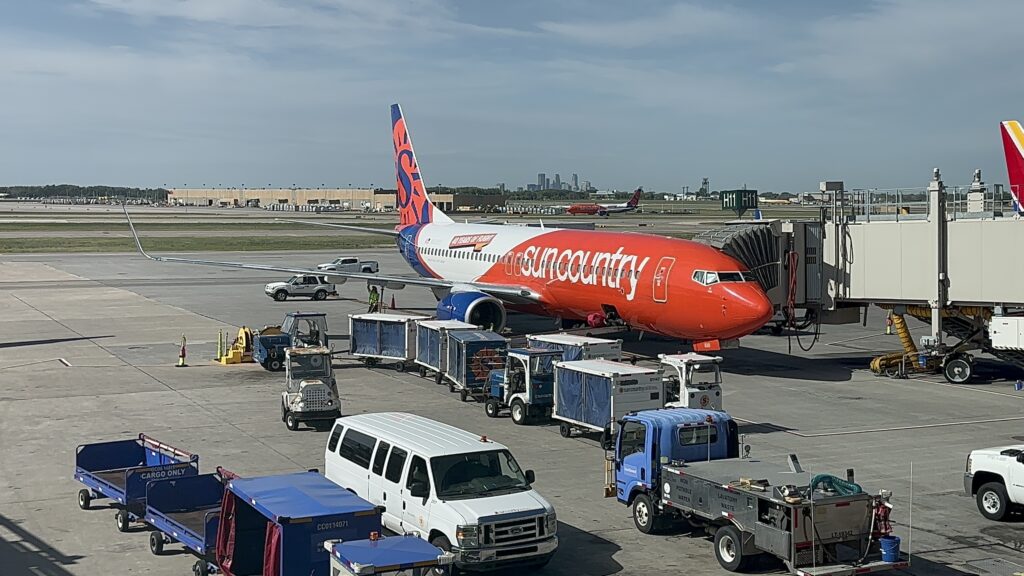
From a fleet perspective, the merger makes somewhat more sense. Sun Country operates an all-Boeing 737 NG fleet, while Allegiant flies a mix of Boeing 737 MAX aircraft and Airbus A319 and A320 aircraft. Sun Country’s 737s should integrate more easily with Allegiant’s existing Boeing pilot base. I would not be surprised to see a greater emphasis on Boeing aircraft going forward to increase commonality. It also would not shock me if Allegiant eventually transitions to an all-Boeing fleet and places additional 737 MAX orders to reduce costs and simplify operations.
Sun Country has struggled for a long time. It began as a small hometown airline with domestic first class, later transitioning into a low-cost carrier and eliminating first class altogether. Over time, it expanded cargo operations and continued evolving toward a more diversified low-cost model. Despite these efforts, Sun Country has often been the weaker airline financially. My concern is that Sun Country’s losses could weigh on Allegiant longer than anticipated. Airline mergers have a habit of failing to deliver the expected profits and synergies.
Additionally, I believe Allegiant should consider targeting more business travel, which tends to be more consistent and higher yielding than purely leisure demand. In the current U.S. market, many low-cost and leisure-focused airlines are under pressure, and a carrier that remains fully leisure-dependent may face challenges ahead. For consumers, this merger is a mixed bag. On one hand, smaller cities could see expanded commercial service. On the other, it removes yet another airline from the market, further consolidating the U.S. airline industry. It remains to be seen whether Allegiant can execute this merger effectively and truly become a profitable, flip-flop focused powerhouse.